When ML wrote La Fête, she was literally lying in the grass at a party. Her thoughts were everywhere, just not there. Too much had happened in a short time. Instead of staying, she chose to leave and walk home. That night, La Fête was written. “It’s not a general state of sadness, but a very specific, fleeting emotion tied to that particular evening.” After a longer pause, La Fête feels like the beginning of something new. It’s the first single of a fresh chapter, and it softly pulls you into her world — nostalgic, subtle, and beautiful. You don’t need to understand French to feel what she’s singing here.
ML, drawn from her real name Maria-Laetitia, is a Belgian singer-songwriter moving somewhere between folk, indie pop, and soft rock. Her music feels warm and unforced, guided by instinct rather than polish. With La Fête, she offers a first glimpse into her upcoming debut album Tout bas, due in spring 2026.
In our interview, we talk about the moments that shape her writing — motherhood, loss, and the bonds that hold — and about learning to trust instinct over noise.
photography by Sasha Vernaeve
I’m listening to your new release La Fête right now — it’s a really beautiful song. I love its understated, slightly melancholic beauty. It’s also your first release after a longer break, during which you became a mother. The song seems to try to capture that feeling: “that blurred moment when collective joy collides with personal sorrow without pathos, without artifice. A candid song, almost light, yet one that lets a discreet spleen seep through, like fireworks watched from afar.” Were you mainly trying to capture this kind of feeling in a general way, or was there a specific situation from your own life that inspired the song?
Thanks! When I wrote La fête, I was literally lying in the grass at a party. It was Belgium’s national day. My grandfather had passed away a few days earlier, and his funeral was the next day. I was feeling really sad around that time, kind of disconnected from everything. I didn’t feel like partying at all, so I went off on my own and wrote this text in one go in a note on my phone. I set it to music later—at first, it was just a piece of writing.
It’s pretty rare for me to write like that: usually, I always work on the music and the lyrics at the same time. I think that’s what makes this text more raw and straightforward. It’s not a general state of sadness, but a very specific, fleeting emotion tied to that particular evening.
How does it feel for you to be “back” with new music? And how much have the new experiences of the past few years influenced the way you make music — for example your style, your overall approach, your expectations of yourself creatively? Or do you feel there isn’t really a difference?
I’m feeling really good. These songs—La fête and the ones that will follow—are very much in line with who I am and with what I’ve always listened to. Somewhere between folk, indie pop, and rock. It feels very warm and organic. My personal experiences have had a big influence on the making of this album, but I think that’s always the case. This time, I became a mother, which is a huge life change. I wrote many of the songs during my pregnancy, or right before and after.
I had two miscarriages before having my son, and those experiences deeply shaped my writing. That’s what gives the upcoming album such an intimate feel. I talk about the great joys of life, but also about grief, sadness, the need to surround myself with friends, and to get back to what really matters.
From a more artistic point of view, this album is the first one where I gave so much space to my brother, Aurelio, as a co-composer. It was a conscious choice, and I couldn’t be happier about it. We played like two kids, recording in the home studio set up in his bedroom. It was simple and effortless, and they’re really good memories.
“I have a very instinctive approach; I try not to overthink what I’m doing when I’m writing.”
For the arrangements of the song, your brother Aurelio (Aurel) was involved, and it was then elevated by Julien Rauis (KAT). What is the best thing about working with your own brother — and what is the most difficult part?
Honestly, I don’t really see many downsides. It’s an incredible opportunity to work with someone so close to me, and to understand each other so well. We were completely aligned on the direction we wanted to take with these songs. I’d bring him my tracks as guitar-and-vocal demos, and we’d start from there. He’s very talented, plays a lot of instruments, and above all he has a lot of artistic freedom. We have fun—it feels like a game.
We share a huge amount of references, which really helps. Of course, there were a few moments of doubt about certain directions—sometimes we’d get stuck on a song for a few hours, or disagree. But in the end, it always worked itself out, and each track found its place, its own identity.
Another big advantage of working with my brother is that I don’t have anything to prove to him, no roles to play. I can be 100% honest and fully myself with him. If he chooses an arrangement I don’t like, I just tell him—plain and simple. And it goes both ways. In the end, the album really sounds like us.
Julien helped us toward the end of the process, when we were no longer seeing things very clearly. He brought in some fresh ideas. He has a very sharp ear and a real sense of detail, which really allowed the album to be polished and finished in the best possible way.
“In life, the things we say ‘tout bas,’ in a whisper, are often the most powerful.”
The song is also a small announcement of your debut album Tout bas, due in spring 2026. What does the title mean, and where did you write the album? And how personal are the songs on the record?
The album is called Tout bas, after the song of the same name. I wrote it after my second miscarriage. It echoes the grief we go through in silence, and I dedicate it to all my friends—close or more distant—some of whom have been through really difficult experiences over the past few years. I wanted to give the album that title because I love the sense of intimacy it carries. And also because, in life, the things we say “tout bas,” in a whisper, are often the most powerful.
I wrote this album in so many different places: my little home studio, my living room, on a train, in Canada (during a songwriting camp I did there in 2024). The songs on it are the most personal I’ve ever written. They talk about wounds of the body and the heart, the grief we keep to ourselves, the strength of our bonds, my son, and the love and friendship that rise above all of that.
Do you usually write the melody first when you work on your songs, or do the lyrics and the theme come first?
Usually, I write both at the same time. I strum my guitar, a melody comes to me, and the lyrics follow. Sometimes—like with La fête or certain parts of Tout bas—the text comes first, and I set it to music afterwards. It really varies. I have a very instinctive approach; I try not to overthink what I’m doing when I’m writing.
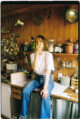
“Love can be complicated, but in the end, it can also be very simple.”
How did you first get into music? And which instruments do you play?
I started music as a kid—I learned music theory and played the flute. As far back as I can remember, I’ve always loved singing. Around 16, I learned to play the guitar with the help of my brother Aurelio, and started writing my own songs, thanks to him again. He was in a band called Lucy Lucy that was doing pretty well. He invited me to sing on one of their tracks, Bottom First, and that was it! I joined them on stage, and it was so amazing that I thought: I wanna do this too.
I play guitar, piano (just a bit), and the flute.
Are “ML” actually the initials of your real name, or what’s the story behind your artist name?
It’s the initials of my real name: Maria-Laetitia. Everybody calls me ML since I’m like 12. I thought it was a simple and good artist name as well.
What was your very first favorite band or musician?
As a teenager, I was a huge fan of Avril Lavigne (laughs). But I think the artists that shaped me as a teenager were Coldplay, Johnny Cash & June Carter, Girls in Hawaii, The Strokes, Gorillaz, Elliott Smith…
Love means…
Wow, huge question. There is nothing more complex than that. I mean, nothing less linear and far removed from everything we are taught as norms. I love the vision of love that emanates from the song Our House by Crosby, Stills, Nash, and Young. I even sang it at my wedding. It’s a vision of love found in the simple things in life. Love can be complicated of course, but in the end, it can also be very simple (laughs).
And finally — your wishes for 2026?
Do my best. Take the time and above all, appreciate the good things when they come.

Listen herre: https://open.spotify.com/intl-de/album/6WqYMT2LZXhLgpMUZWZPjm
Follow ML for more:
www.instagram.com/ml.musique