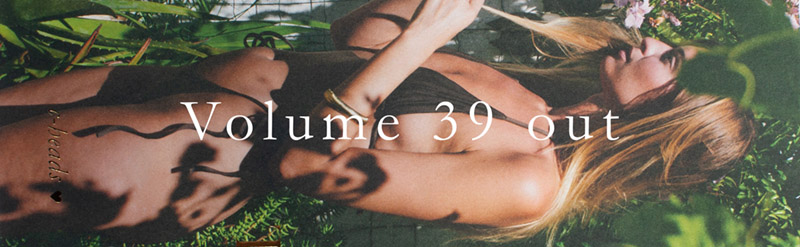

Today, our attention turns to Kelly – to the responsibility of “deciding who you become when crisis no longer gives direction.” After a cancer diagnosis came treatment, and then the unfamiliar after: the moment when the medical structure falls away, and you’re returned to life without instructions. Nothing comes back the same. As she puts it, “Survival didn’t feel like a finish line. It felt like renegotiation.”
And with it came the snowkini series she had imagined for years, shot on film with a vintage sensibility, rooted in nostalgia, presence and physical freedom – a refusal to postpone, and choosing the moment anyway.
“You’re returned to your life without the illusion that it’s all going to hold together.” What follows is a conversation about moving forward without guarantees.
Photography by Clarin J
Kelly, lovely to have you with us. You went through a major health experience that completely changed your life – would you like to tell us a little more about that?
Rewind to March 2024, I had decided to leave my life in Hawaii and move to Belize. I was drinking heavily, sick, and had just ended a relationship that had severed my confidence. It felt like reinvention, but let’s be real, it was an escape. At the airport, on my way out, I got a call from my doctor saying I needed further imaging. A few months later, after additional imaging, I was told the tumors were “probably benign”. So, I kept drinking. I kept ignoring what my body was trying to tell me. I remember being so sick one night and saying to my mother, very calmly, “Something is REALLY wrong with me.” The misdiagnosis that nearly killed me also exposed everything that was already killing me slowly. I had been postponing my own life. Numbing just made delay easier. The cancer diagnosis didn’t save me — it removed my ability to hide. Cancer changed me. But more than that, it ended the version of my life that depended on avoidance.
Many people expect survival to feel like relief – for you, it sounded more like uncertainty. Can you describe that space right after treatment ended?
When treatment ended, people expected relief. I felt absence. During treatment, there’s structure — appointments, lab results, metrics, something to fight. When it all stops, it’s like the scaffolding disappears. You’re returned to your life without the illusion that it’s all going to hold together. The loneliness surprised me. The texts slow down. People don’t know what to say anymore, so they say less. Some are overly careful. Others assume you’re “back.” There’s an expectation that you’ll be strong — as if there were another option. Strength becomes a role you’re handed. It’s exhausting. I wasn’t afraid in this dramatic way. I was unsettled in a practical one. I didn’t trust my body automatically. I hesitated to plan too far ahead. But alongside the uncertainty, there was clarity.
Cancer strips away abstraction. It makes risk visible. It exposes what you’ve been postponing. The future stops feeling implied and starts feeling chosen. Survival didn’t feel like a finish line. It felt like renegotiation — with my body, with time, and with what I was no longer willing to delay.
Did you feel that others suddenly saw you through a new label – “patient”, “survivor”, all of that?
The labels felt complicated. “Patient” felt temporary. “Survivor” felt conclusive — and that never resonated with me. You’re never really finished with cancer. The appointments don’t stop. The fear doesn’t disappear. Every ache carries a question. What unsettled me most was when people called it “a blip on your radar.” Maybe in the span of a lifetime it is. But my radar is different now. It’s more sensitive. More attuned. I measure risk differently. I imagine time differently. It wasn’t the label itself that bothered me. It was the assumption that the story had ended.

“My radar is different now. More sensitive. More attuned.”
Your relationship with your body shifted so much. What was the first moment you realized you had to get to know yourself again – physically?
It was in January 2025, when I went back to the gym after reconstruction. My body felt unfamiliar — scarred, hormonally altered, thrown into menopause without consent. I didn’t feel delicate. I felt underestimated. There’s a cultural script for women who go through this – and I could feel it waiting for me. Lose your breasts. Age overnight. Accept the softening. Accept the shrinking. Accept the pity. I rejected it. I had always been active, always “strong” — but this wasn’t lifestyle strength. This was a confrontation. I wasn’t trying to “bounce back.” I just wasn’t willing to disappear. Going back to the gym wasn’t about aesthetics at first. It was a revolt. Not against my body — but against the narrative attached to what was happening to it. Against the idea that femininity expires. Against the assumption that scars make you less visible. I wasn’t “going back” to anything. I was redefining visibility.
And emotionally – how important were other people during that time? Did support make a real difference, or did it still feel like something you had to move through alone?
It was both — but it was lonelier than I expected. I had just moved to a new town, and I didn’t know anyone. I was supposed to be living my 22 year old dream of living abroad. I had left Hawaii thinking I was stepping into a new life, and instead I was back in the States because of a “probably benign” misdiagnosis that turned out not to be benign at all. I missed my old life. I missed my friends. But more than that, I missed the version of myself who hadn’t been interrupted. I had some family nearby, and a few people visited. Their presence mattered deeply. But most of the experience was quiet. Cancer rearranges proximity, and when you’re new somewhere, there isn’t a built-in net. Friends I assumed would be there – disappeared. Others — people I hadn’t expected — showed up in steady, quiet ways. Cancer forces people to confront fragility, and not everyone is comfortable standing close to that. Support made a real difference. But the internal reckoning was solitary. No one could sit inside the uncertainty for me. No one could decide what I was willing to return to once treatment ended. Overall, I think people showed up where they could. The rest was mine to navigate.
You returned to the gym quite early – and I really relate to this. I love the gym not only for my body, but for my mental health too. What role did movement play for you in finding trust in your body again?
Movement became essential. Medical menopause altered my emotions in ways I wasn’t prepared for. The swings were – and still are – very real. The flatness – real. The volatility – real. And yet it’s something we rarely talk about openly. Society glosses over menopause — especially when it happens abruptly and medically. There’s this quiet expectation for women to absorb it gracefully. I wasn’t interested in absorbing anything quietly.
The gym became my antidepressant — not because it fixed everything, but because it stabilized me. It gave my mind and my body somewhere to land. Fixed, scheduled. At first, I’ll be honest, it was defiance. I was determined not to gain the “menopause weight” everyone warns you about. There was ego and a whole lot of rebellion in that. But it evolved. It stopped being about rebellion and became about truly testing capacity. What could this body — scarred, hormonally disrupted, underestimated — actually do? Lifting rebuilt trust in increments. Rep by rep. It grounded my emotions when they felt unpredictable. It reminded me that even if my hormones were fluctuating, my effort was measurable. Menopause won’t make me disappear. If anything, it makes me more deliberate about how I show up.

“You’re returned to your life without the illusion that it’s all going to hold together.”
There’s often pressure to tell a “strong and positive” illness story. Did you ever feel pushed toward a version of yourself that wasn’t true?
Yes — but it feels less like individual pressure and more like a cultural expectation. There’s a collective narrative around illness: be strong, stay positive, inspire others. It’s well-intentioned, but it assumes you have the energy to compartmentalize your own suffering. As a cancer patient, you’re already tired enough. You’re tired from treatment. From appointments. From uncertainty. From managing other people’s fear. The idea that you should also package it into something uplifting can feel like another task on an already overloaded list. I understand why the pressure exists. Positivity reassures people. It makes the experience easier to digest from the outside. But I am no longer interested in performing for other people’s comfort. Strength, for me, wasn’t about smiling through it. It was about telling the truth — even when that truth included anger, loneliness, or ambiguity. I don’t want to flatten something ongoing into a clean, inspirational arc. My story hasn’t ended. And it doesn’t need to be edited into something tidy to be meaningful.
How do you plan a future when certainty feels more fragile than before?
I don’t assume anything anymore. Before, the future felt implied – like time would just cooperate. After cancer, that illusion dissolved. Not in a dramatic way — just in a clarifying one. Certainty was never promised. We are all just comfortable assuming it is. Fragility hasn’t made me cautious. If anything, it’s made me bolder. I don’t postpone as easily. If something matters, I move toward it — not recklessly, but without waiting for conditions to feel perfect. The fear is still here. Every appointment carries a question, anxiety. But that awareness doesn’t paralyze me anymore. It sharpens me. I don’t plan because I’m guaranteed anything. I plan because I’m choosing to.
You’ve said cancer doesn’t end – it recedes. How do you live with something that’s present, but mostly invisible?
I live with it the way you live with background noise. It’s not always loud, but it’s never completely gone. I talk about cancer openly. I show my scars. I don’t hide the experience. But the internal layer of it — the recalibrated awareness, the pause before appointments, the fear of recurrence that surfaces with certain aches or test results — that part is mostly invisible. There’s a duality to it. Outwardly, life looks vibrant. Strong. Active. Snowkini shoots in winter. Lifting heavy. Planning boldly. Internally, there’s a quiet hum running underneath it all. I don’t try to silence it. I’ve just learned to live alongside it. Cancer recedes, but it doesn’t disappear. It becomes part of the background — not dominating, but always there. It’s not a constant crisis. It’s a constant awareness. And I’ve learned that awareness doesn’t have to be dramatic to be powerful.

“I wasn’t trying to bounce back. I just wasn’t willing to disappear.”
The snow series with Clarin J feels powerful. What drew you to that landscape – and to swimwear in the snow?
The snowkini photoshoot with Clarin J felt full circle. Years ago, I owned my own swim line, and Clarin shot one of my campaigns. Swim was part of my creative identity — confidence, exposure, movement, warmth. When I left Hawaii and was diagnosed, I had to let that business go. That chapter closed abruptly. So returning to swim — especially in the snow — felt intentional. Cold landscape. Bare skin. Film. There’s a tension in that contrast that mirrors the last few years of my life. Strength against fragility. Visibility against the expectation to shrink. It wasn’t about nostalgia. It was about reclamation. There’s also a quiet rebellion in putting swimwear where it “doesn’t belong.” It disrupts the polished fantasy of warmth and ease. It says: this body doesn’t wait for perfect conditions. I had to let go of that part of my life once. Shooting Snowkini wasn’t about going backward. It was about proving to myself that I could return to it — differently, deliberately, on my own terms. It wasn’t about going back. It was about choosing differently. I didn’t survive to become cautious.
Okay, a lighter one – are you more a winter or summer person? (smiles)
I used to say summer…all day long. Although lately, I respect winter more. It forces stillness. It reveals what’s strong enough to stand.
What has been a small everyday joy for you lately – something simple but real?
Walking and letting my mind just wander and letting those pesky worries wait.
And just for fun: coffee or tea, early mornings or late nights?
Coffee. Early mornings. The quiet feels earned now.


Photography by Clarin J www.instagram.com/clarin__j
Muse: Kelly www.instagram.com/pr413